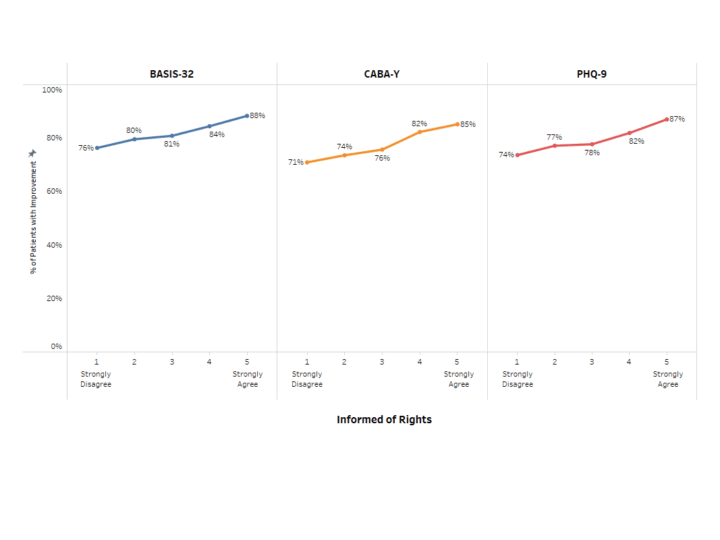
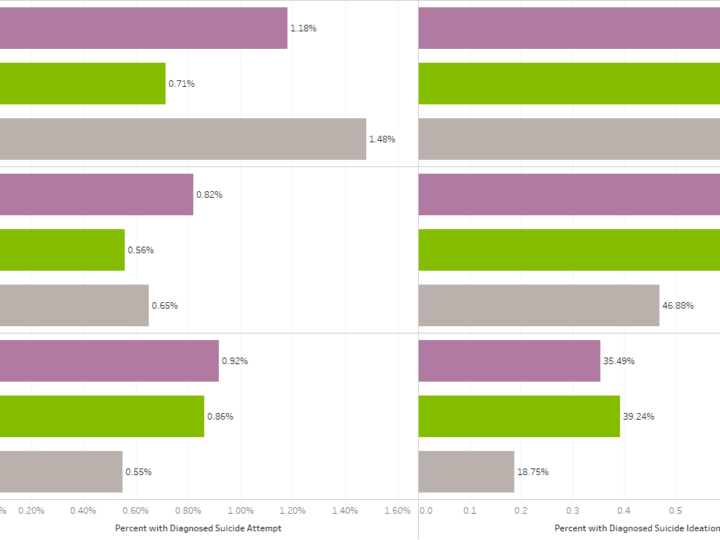
Many older adults, 65 and over, receive behavioral health care either in mixed-aged adult programs or specialized geriatric psychiatry programs. However, recent literature suggests that “older adult” is not a singular construct. Rather it represents diverse functional abilities, clinical presentations, and treatment needs.
Research on aging often uses three distinct phases of aging: ages 65–74 (youngest-old), ages 75–84 (middle-old), and ages 85+ (oldest-old). These groups each have unique clinical considerations that significantly influence psychiatric presentation. The youngest-old adults may be highly independent, adjusting to retirement or changes in routine and identity. In contrast, older patients are more likely to experience declining physical function, increased medical comorbidities, and greater social isolation.[1][2]
Inpatient older adults in MHO’s data were explored using these age groups to compare stages of aging across these age groups and to adult inpatients in general. Age-group differences are evident. Compared to adults under 65, older adults have more comorbid medical conditions, longer length of stay, and decreased suicidal ideation. Notably, they are more likely to receive psychiatric diagnoses linked to underlying physiological conditions. These disparities become increasingly pronounced with each advancing age group.
Figure 1. Characteristics of Older Adults (interactive graph)

As patients move through stages of older adulthood, symptom patterns on patient-reported outcomes such as the BASIS-32TM and PHQ-9 shift. [3][4] In general, older adults report lower symptom severity on patient reported assessments compared to younger adults [5]. This trend appears progressive, with each age cohort demonstrating a lower average severity than younger groups.
Lower symptom severity between groups can mask important individual differences. With increases in age, patient psychiatric symptoms may be interacting with more complex medical and functional needs, which affects assessment and care planning. Alternate assessments to the BASIS-32TM or the PHQ-9 may be more appropriate if patients are experiencing cognitive or functional challenges and these patients may not be directly comparable to other groups.[6]
Figure 2. Patient Reported Outcomes – Symptom and Functioning Patterns for Older Adults (interactive graph)

Though symptom presentation differs across older adult stages, it doesn’t mean a patient is not experiencing psychiatric illness such as depression or anxiety. Importantly, there is age related context to how the patient is relating to their illness. Depression, for example, may not appear as overt sadness, but instead patients report sleep or appetite disturbances. Similarly, anxiety may center on tangible health concerns and functional decline, or fear of losing independence. [7]
Visualizing symptom patterns across older adult subgroups can further enhance clinical insight, helping providers identify trends and tailor interventions accordingly. MHO’s data align with existing literature: older adults exhibit distinct symptom patterns that continue to change across stages of aging.
How does this influence clinical practice?
- Assessment of psychiatric symptoms for older adults requires an approach that considers psychiatric symptoms as well as chronic medical conditions, functional status, and cognitive capacity.
- Effective care models must address the intersection of mental and physical health, functional limitations, and social determinants that are common during different stages of aging.
- Treatment response may vary due to physiological changes, increased medication sensitivity, and cognitive factors associated with aging.
- Comparing patients within similar age or functional cohorts can improve the interpretability of assessments and support more effective outcome monitoring.
It’s important to note that examining symptom profiles by age cohort has two key limitations. First, these data are not longitudinal so we cannot test if symptom severity decreases for specific individuals over time. Second, with each progressive age group the sample becomes smaller. It is possible that oldest-old in inpatient care may not be representative of typical patients at that age. Oldest-old adults with the highest symptom severity may have physical disorders or cognitive issues that prevent them from completing assessments or even attending traditional inpatient programs.
Ultimately, though, data show delivering effective care to older adults requires a nuanced approach with acknowledgment of the complexity and diversity of aging.
References
[1] Lavingia R, Jones K, Asghar-Ali AA. A Systematic Review of Barriers Faced by Older Adults in Seeking and Accessing Mental Health Care. J Psychiatr Pract. 2020;26(5):367-382. doi:10.1097/PRA.0000000000000491
[2] Poganik JR, Gladyshev VN. We need to shift the focus of aging research to aging itself. Proc Natl Acad Sci U S A. 2023;120(37):e2307449120. doi:10.1073/pnas.2307449120
[3] BASIS-32: The Behavior and Symptom Identification Scale is a self-report measure of a patient’s functioning, rated on a scale of 0 “no difficulties” to 4 “extreme difficulties”. BASIS-32 © Mclean Hospital, used by licensee with permission from Mclean Hospital.
[4] Kroenke K, Spitzer RL, Williams JB. The PHQ-9: Validity of a brief depression severity measure. J Gen Intern Med. 2001;16(9):606-613.
[5] Min SH, Topaz M, Lee C, Schnall R. Understanding changes in mental health symptoms from young-old to old-old adults by sex using multiple-group latent transition analysis. Geroscience. 2023;45(3):1791-1801. doi:10.1007/s11357-023-00729-1
[6] Zhao H, Chen J. The prevalence and clinical correlation factors of cognitive impairment in patients with major depressive disorder hospitalized during the acute phase. Front Psychiatry. 2024;15:1497658. Published 2024 Nov 15. doi:10.3389/fpsyt.2024.1497658
[7] Harlev D, Vituri A, Shahar M, Wolpe N. Depression and anxiety symptom networks across the lifespan. Age and Ageing. 2025:; 54(6). doi: 10.1093/ageing/afaf153